
Wednesday, September 7, 2016

thursday 8.9.16 consultation
i shall be in my office and available for consultation from 11.37
and we shall use the afternoon session to consult further as a class
so you may either come to my office or hold your breath till we meet in the afternoon
and we shall use the afternoon session to consult further as a class
so you may either come to my office or hold your breath till we meet in the afternoon
Wednesday, August 17, 2016
Monday, August 15, 2016
Strong examples
below are examples of how to begin to construct an urban narrative.
it begins with a thought, that thought is formulated into text and the text becomes an illustrative graphic


it begins with a thought, that thought is formulated into text and the text becomes an illustrative graphic


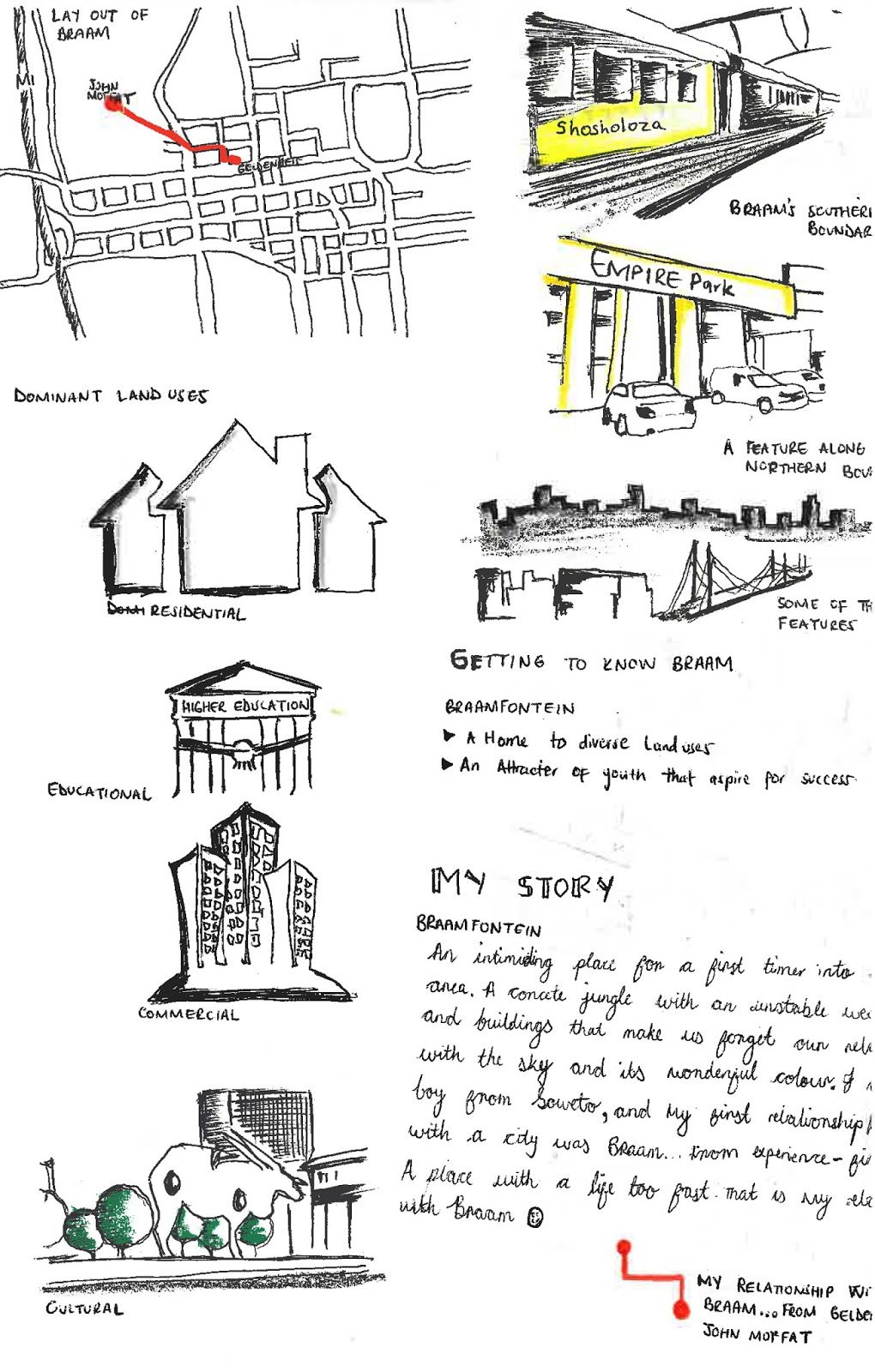


Tues 16 Aug 2016_MUD Accessible Studio_Braamfontein
The Masters of Urban Design students are presenting their findings of Jorissen Street + the Braamfontein locale.
Schedule:
Schedule:
09.00 – 10.13:
Group A_West of De Beer
10.15 – 10.30:
break
10.35 – 11.48:
Group B_East of De Beer
Crits will take place in the School of Architecture and Planning
post graduate basement
You may attend the session if you feel you may benefit form the discussion
16 August Task_3.1 Crit

Task_3.1
– Base Map
Production
1 Collecting
Base
Maps:
Plan,
Sections, Elevations + Thresholds (magnetic points). Plan should include axonometric of selected
strategic areas. The key layer should be
the identification of thresholds: kerbs, edges, steps, awnings, trees, etc. Place the street under a microscope to expose
what is normally omitted.
Photographic
storyboard and drawings including the thresholds uncovered on by the base map
should be used to explain the project.
Samples may include the following: edge conditions, windowsill, fences,
garbage bins, streetlights, parking spaces etc.
Photographic recordings
and other mapping techniques will serve to represent this complex phase
together with a proposed research matrix on a plan in the making. Unstructured interviews will be part of the
scanning process ‘to expose the researcher to unanticipated themes and to help
him or her to develop a better understanding of the interviewees’ social
reality from the interviewees’ perspectives.’
(unstructured interviews by Yan Zhang and Barbara M. Wildemuth,
https://www.ischool.utexas.edu/~yanz/unstructured_interviews.pdf)
16 Aug Crit session will begin at 14
that means class will begin at 14
groups need to begin setting up at 13.45
groups a - e are to use the time from 10.15 - 13.00 to structure and concise their block arguments.
schedule for crits is:
14.00 -- 14.15 intro
14.20 -- 14.37 group e
14.40 -- 14.57 group c
15.00 -- 15.17 group a
15.20 -- 15.37 group b
15.40 -- 15.57 group d
16.00 -- 16.15 break
16.17 -- 17.00 reflection + Learning from the Street. Space Perceptions + Edge Condition Concept
Tuesday, August 9, 2016
task_3
construct an active street
three scenes in the life of . . .
active streets elements:
- choose 5 protagonists that act a leading characters
- write a draft of their life circumstances. this shall be based on 'real' facts- look at news articles, photo documentaries, do unstructured interviews with people.
- construct 3 scenes of their lives in section/ plan, axonometric
scenarios may revolve around the following themes
going out/ to work
coming back
free day
+ the concepts of dwelling
work in five [a-e] groups of three, each group has one protagonist, each group member has one or multiple scenes.
three scenes in the life of . . .
active streets elements:
- thresholds
- safety
- people
- services
- transport
- choose 5 protagonists that act a leading characters
- write a draft of their life circumstances. this shall be based on 'real' facts- look at news articles, photo documentaries, do unstructured interviews with people.
- construct 3 scenes of their lives in section/ plan, axonometric
scenarios may revolve around the following themes
going out/ to work
coming back
free day
+ the concepts of dwelling
work in five [a-e] groups of three, each group has one protagonist, each group member has one or multiple scenes.
Subscribe to:
Posts (Atom)